
Planning a trip to China on a budget? You have likely seen 7 Days Inn (7天酒店) everywhere. With their bright yellow and blue signs, they seem like the perfect cheap option.
But if you are a foreign passport holder, trying to check into one can be a massive gamble—especially once you leave the major tourist hubs.
As a foreigner who reads and writes Chinese and has spent over a decade living in the US, I have navigated this system firsthand. Here is the unvarnished reality of how these ultra-budget hotels work, why the staff panics when you arrive, and how to survive the check-in process.
What Actually is a 7 Days Inn?
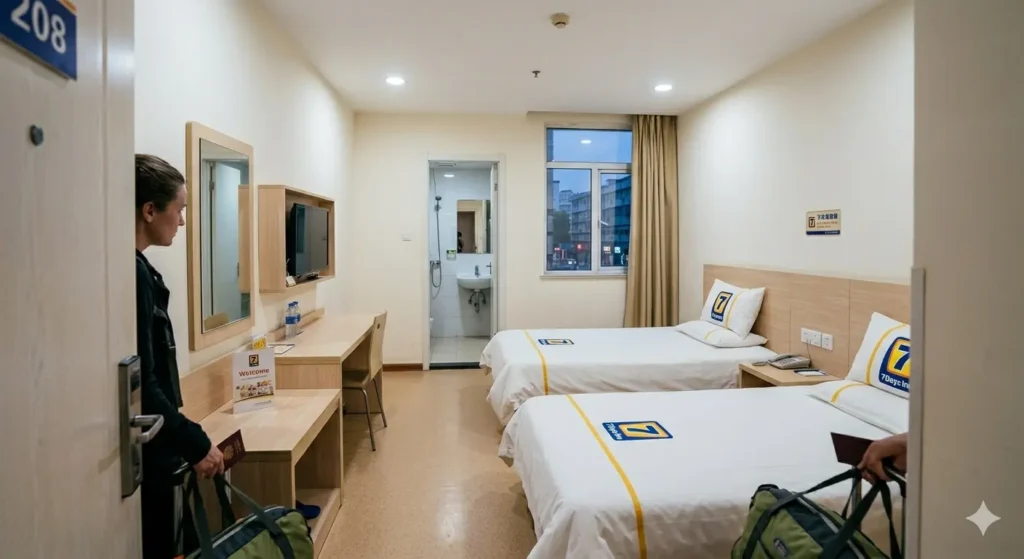
To put it in a Western context, 7 Days Inn is the Chinese equivalent of a Super 8, Motel 6, or Days Inn.
Expect a basic, clean bed, a private bathroom, and minimal amenities. One unique quirk to keep in mind: breakfast is rarely included. If they do offer it, you will normally have to pay a separate fee of around 15 RMB per guest for a simple, Chinese-style buffet (usually congee, steamed buns, and eggs).
It’s Not Just English—It’s the Concept
Even though the hotel’s police system is written entirely in Chinese, the concepts are completely foreign to workers who rarely see international travelers. Staff routinely get stuck on fields like:
- Port of Entry (入境口岸)
- Visa Type (签证种类)
- Visa Expiry Date (签证有效期)
The Fear of the Local Police
In major tourist destinations (like Shanghai, Beijing, or Xi’an), budget staff are well-trained. But if you venture into remote or western cities where foreigners rarely visit, the staff becomes visibly nervous.
The stakes are high for them. I once witnessed a panicked front-desk worker on the phone with the local police, literally being yelled at because they didn’t report a foreign guest’s information correctly. Because mistakes lead to heavy fines or reprimands from local authorities, a clerk’s easiest defense is simply to tell you, “No foreigners allowed.”
Insider Pro-Tip: Because I read Chinese, I have actually stood behind the counter and helped staff key my own information into their system. If you can read basic Chinese or use a translation app, offer to guide them through your passport pages to find your visa type and entry stamp. Helping them type it in can save your night.
How to Guarantee a Frictionless Booking
Many travelers believe you can only book foreigner-approved hotels through international sites like Trip.com. However, if you can read basic Chinese or use a browser translator, domestic Chinese booking apps (like Meituan, Fliggy, or the domestic Ctrip) are incredibly efficient.
Domestic apps explicitly label exactly who a hotel can legally accommodate. Look for these tags on the listing:
- 外宾 (Wàibīn – Foreign Guests): This means the hotel is fully cleared, and the staff should know how to handle your passport. Booking these makes your check-in entirely frictionless.
- 内宾 (Nèibīn – Mainland Guests Only): Avoid these entirely. Even if the app lets you pay, the front desk will reject your passport upon arrival.
📋 Quick Checklist for Booking Chinese Budget Stays
- Carry Your Physical Passport: Photocopies or phone screenshots will not work. They need to see the physical visa and your most recent entry stamp.
- Keep 15 RMB Ready: Breakfast is almost always an add-on fee paid at the counter.
- Download Translation Apps: Have WeChat, Alipay, or Google Translate (with offline Chinese) ready so you can translate the desktop check-in screen for the clerk if they freeze up.
- Expect Friction in Remote Areas: If traveling to western or less-visited provinces, opt for slightly higher-tier budget chains like Jinjiang Inn (锦江之星) or Hanting Premium (汉庭), where staff training is generally superior.